Best AI Storyboard Generators for Marketers in 2026
Sohel
June 24, 2026
7 min read
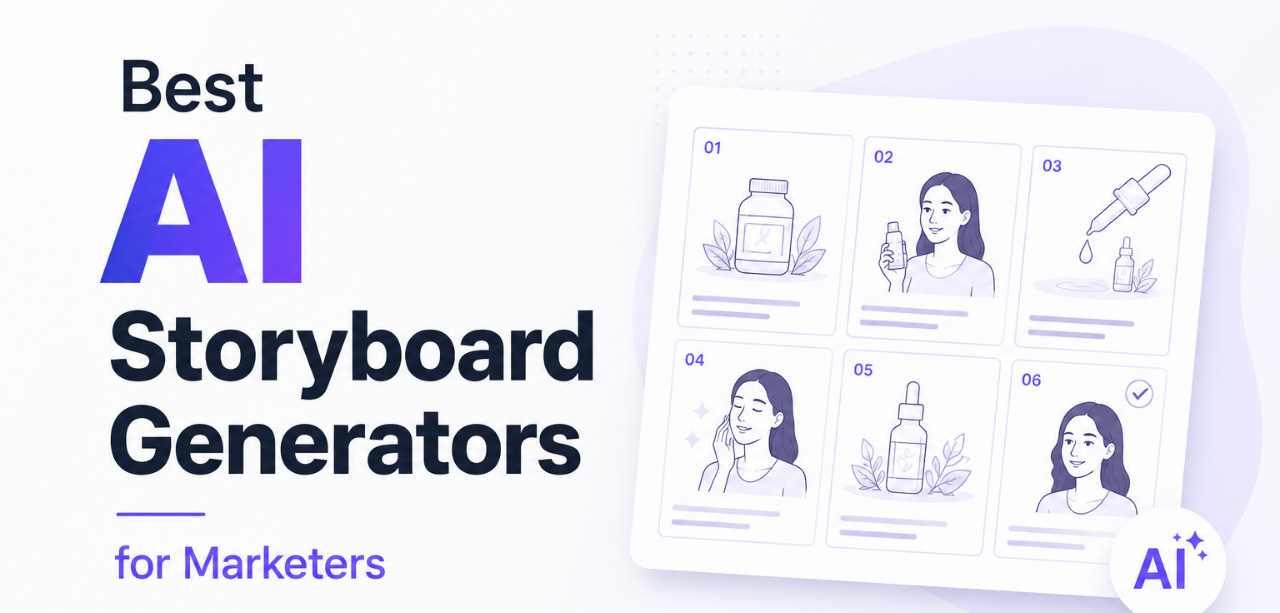
Video marketing has never been more competitive. Brands and agencies are producing more ad content than ever — across social media, streaming platforms, and digital channels — and the pressure to deliver high-quality creative quickly is intense.
Traditionally, creating a storyboard meant hours of manual sketching, back-and-forth revisions, and expensive creative resources. Today, AI storyboard generators are changing everything. Marketers can now transform a simple brief into structured visual scenes in minutes — without design skills or large production budgets.
In this guide, we break down the best AI storyboard generators for marketers in 2026, what to look for, and which tools stand out for speed, simplicity, and ad-focused workflows.
An AI storyboard generator is a software tool that uses artificial intelligence to convert a marketing brief, script, or concept into a sequence of visual scenes — complete with descriptions, dialogue cues, and layout suggestions.
Instead of manually arranging frames and writing scene directions, marketers input their campaign idea and the AI does the heavy lifting: structuring scenes, suggesting visuals, and producing a ready-to-review storyboard in a fraction of the time.
These tools are especially valuable for ad agencies, brand teams, and content creators who need to move fast from concept to production.
AI storyboarding tools solve some of the most common pain points in creative production:
Dilogs AI is purpose-built for marketers and ad teams. Its AI-powered storyboard generator converts marketing briefs into structured visual storyboards — making it one of the fastest tools available for ad pre-production.
What sets Dilogs AI apart is its ad-focused workflow. Rather than a generic storyboard tool, it is designed specifically for the type of content marketers actually create: social media ads, branded video concepts, product campaigns, and agency client work.
Key highlights:
For marketers who run multiple campaigns simultaneously, Dilogs AI’s speed and simplicity make it the clear choice. It is not a general-purpose creative tool — it is built for the way marketers actually work.
| Dilogs AI AdvantageDilogs AI also supports image-to-video ad generation, allowing teams to take their storyboard concepts and bring them to life as video ads — all within a single platform. This end-to-end workflow makes it uniquely powerful for modern marketing teams. |
Boords is a well-established storyboarding platform popular with video production studios and agencies. It offers a clean interface, frame-by-frame editing, and solid collaboration features.
Key features:
Boords is best suited for post-production and film-focused teams. For marketers focused specifically on ad creative, it lacks the AI-powered brief-to-storyboard automation that tools like Dilogs AI offer.
StoryboardHero uses AI to generate storyboard frames from scripts and video concepts, making it useful for content teams that work from written scripts.
Pros and cons:
StoryboardHero works well for individual creators and small teams but may not scale efficiently for agencies managing multiple brand campaigns.
Canva includes storyboard templates as part of its broader design platform, making it a popular choice for marketers already using Canva for other creative work.
Strengths:
However, Canva is not an AI storyboard generator in the true sense. Storyboard creation is manual — users arrange frames and add content themselves. For teams that need AI-powered scene generation from a brief, Canva is not the right fit.
Milanote is a visual planning and mood-boarding tool popular with creative directors and brand strategists. It offers a flexible canvas for arranging images, notes, and references.
Visual planning and creative workflow benefits:
Like Canva, Milanote is not built for AI storyboard generation. It is a manual creative planning tool best used in the early conceptual stages of a campaign, rather than for structured ad storyboarding.
Not all storyboard tools are created equal. When evaluating an AI storyboard generator for your marketing team, look for:
Beyond saving time, AI storyboard generators have a measurable impact on marketing performance:
While several tools on this list offer storyboarding features, Dilogs AI stands out as the option built specifically for marketing and advertising workflows.
Here is why marketing teams and agencies choose Dilogs AI:
For brands and agencies looking to accelerate their creative pipeline without inflating their production team, Dilogs AI offers a purpose-built solution that few other tools can match.
| Try Dilogs AI: Dilogs AI combines AI storyboarding with image-to-video ad generation — giving marketers an end-to-end creative workflow from concept to final video ad. Explore what Dilogs AI can do for your next campaign at dilogs.ai. |
The best AI storyboard generators for marketers in 2026 share one thing in common: they remove the friction between a great campaign idea and a polished visual concept. Whether you are a solo marketer, a growing brand team, or a full-service agency, AI storyboarding tools are now an essential part of any efficient creative workflow.
While tools like Boords, Canva, and Milanote offer value for specific use cases, Dilogs AI is the standout choice for marketers who need speed, ad-focused functionality, and the ability to scale creative production without expanding headcount.
Adopting AI in your creative workflow is no longer optional — it is a competitive advantage. And with tools like Dilogs AI, getting started has never been easier.