What Is a Spec Ad How Do You Make One?
Sohel
May 2, 2026
11 min read
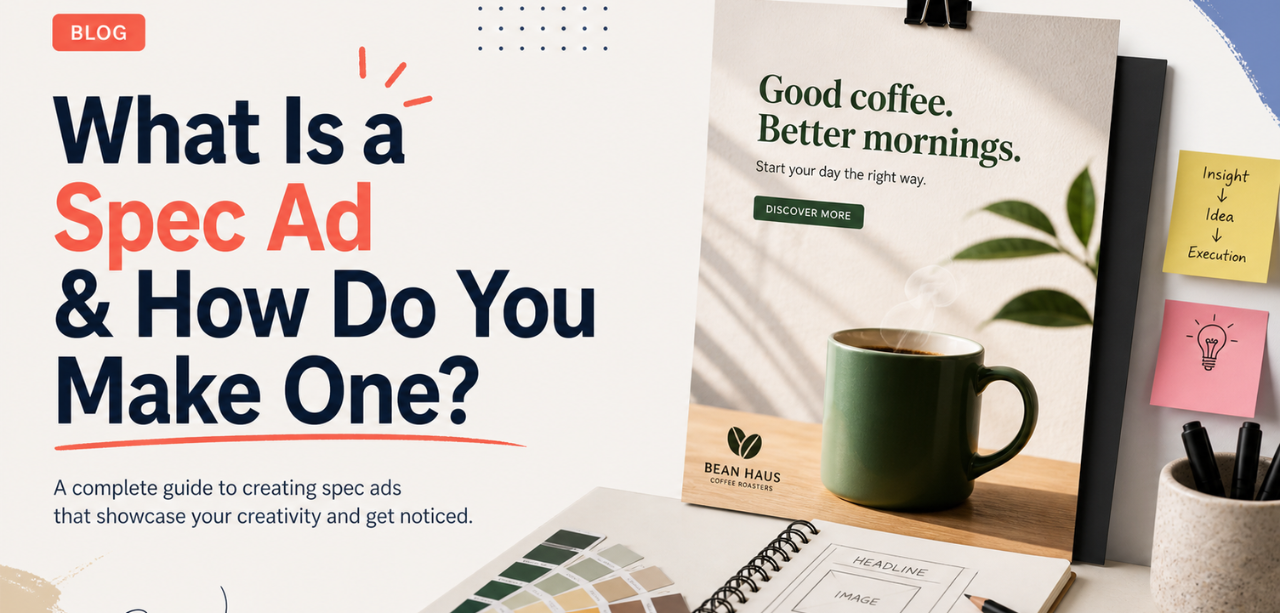
You have the skills, the eye for storytelling, and the drive to work with great brands, but your portfolio is empty, and no one’s handing you a brief just yet. Sound familiar? This is exactly where a spec ad changes everything.
Whether you’re a copywriter, art director, videographer, or aspiring creative director, spec ads are one of the most powerful tools available to break into the industry, sharpen your craft, and show the world what you’re capable of without waiting for permission.
A spec ad (short for speculative advertisement) is a self-initiated, unpaid piece of advertising created for a real brand without any formal commission or brief from that brand. Think of it as a creative exercise or portfolio project. You pick a brand you admire, invent a campaign concept, and execute it as if it were the real thing.
Spec advertising means, in plain terms, you’re doing the work on spec, speculation, betting that the quality of your output will open doors.
Spec ads aren’t fake ads. They’re really creative works. The only difference is that no client paid for them. Yet.
In a world where brands spend billions, and creative agencies are flooded with applicants, your raw talent alone won’t get you the meeting. Spec ads level the playing field.
Here’s why they matter:
Agencies and creative directors know what spec ads are. When done well, they carry real weight.
| Factor | Spec Ad | Real Client Ad |
| Client involvement | None | Full briefs, revisions, and approvals |
| Budget | Self-funded (usually $0) | Paid production budget |
| Deadline pressure | Self-imposed | Hard client deadlines |
| Creative freedom | Maximum | Constrained by brand guidelines |
| Risk | Low | High reputations on the line |
The upside of spec ads is creative freedom. The challenge is discipline — you have to impose your own standards without anyone pushing back.
Don’t just pick your favourite brand, pick one that gives you creative room to work.
Ask yourself:
Strong spec ad examples often come from reimagining established brands freshly — not copying their existing style.
Before you write a single word or sketch a single frame, become a student of the brand.
Study:
This research phase is what separates a thoughtful spec ad from a generic one. Great spec ads feel like they could have come from the brand’s own agency.
Every strong ad speaks to someone specifically. Define your audience with precision:
Knowing your audience shapes every creative decision that follows — the tone, the platform, the pacing, the humour (or lack of it).
This is the heart of your spec ad. You need one clear, compelling idea — a single thought that everything else hangs on.
A strong concept answers: “What is this ad really saying, and why should anyone care?”
Test your concept with these questions:
Great advertising concepts are often surprisingly simple. The craft is in the execution.
Now translate your concept into a format.
For video or film:
For print or digital:
Keep it platform-aware. A 60-second brand film plays differently than a 6-second pre-roll or a static Instagram post.
Here’s where most beginners stall — they wait for better equipment, more money, or the “right” moment. Don’t.
Production tips for spec ads on a budget:
The goal is a polished, professional-feeling output. Execution matters more than budget.
Your first cut is never your best cut. Leave time to step away, revisit, and edit ruthlessly.
Final checklist before sharing:
Export in formats appropriate for the platform and include it in your portfolio with a brief case study explaining your concept and creative choices.
Artificial intelligence has quietly become one of the most powerful tools in a spec ad creator’s kit. Spec ad AI isn’t about replacing your creative instincts — it’s about removing the production barriers that once kept great ideas from becoming great work.
Whether you’re a one-person team or collaborating with a small crew, here’s how AI fits into every stage of the spec ad process.
Stuck on an angle? AI tools like Claude, ChatGPT, or Gemini can help you pressure-test ideas, generate campaign territories, and explore alternative concepts in minutes. And for spec ad creators specifically, Dilogs AI is worth a close look — it’s built for ad creative workflows, helping you generate structured campaign concepts, ad scripts, and messaging frameworks tailored to a brand’s tone and audience. Feed any of these tools your brand research, target audience, and a rough direction — then use the output as a springboard, not a finished product.
The creative judgment still belongs to you. AI just accelerates the ideation process.
AI writing assistants can help you draft scripts, headlines, taglines, and body copy faster than ever. Use them to:
Think of it as having a tireless writing partner who never runs out of drafts.
This is where spec ad AI has been most transformative. Tools like Midjourney, Adobe Firefly, DALL·E, and Runway ML allow solo creators to produce stunning visual assets without a full production crew.
Here’s how to use them effectively:
A cinematic-looking spec ad that once required a £5,000 shoot can now be produced for zero if you know which tools to use and how to direct them.
No voiceover talent in your contacts? No problem. Tools like ElevenLabs and Murf AI let you generate natural, professional-quality voiceovers in dozens of voices and accents. You can also streamline your workflow with Dilogs AI, which helps integrate voice, visuals, and editing into one place. Pair this with royalty-free music from Suno AI or Udio, and your spec ad has a complete audio landscape.
AI-powered editing tools are cutting post-production time dramatically:
AI is a production tool, not a creative substitute. The brands that agencies care about, the concepts that stand out in portfolios, the ads that actually move people — those still come from human insight about human experience.
Use AI to execute faster and at a higher production level. Use your brain to make it mean something.
| AI Tool | Best For |
| Dilogs AI | AI Ad generation, scripts, messaging frameworks |
| Claude / ChatGPT | Concept development, scriptwriting, copy |
| Midjourney / DALL·E | Visual generation, storyboard mockups |
| Runway ML / Kling | AI video generation and animation |
| ElevenLabs / Murf | Voiceover generation |
| CapCut / Descript | Editing, captions, post-production |
| Suno / Udio | Original background music |
The solo creator using AI today has more production firepower than a mid-sized agency had a decade ago. That’s not a small advantage; that’s a complete shift in what’s possible.
Ans: Absolutely. Spec ad AI tools like Midjourney, Runway ML, ElevenLabs, and Claude are now widely used by creatives to generate visuals, voiceovers, scripts, and music for spec ads, often at zero cost. The key is using AI to enhance your creative vision, not replace it. Agencies value the idea and the strategic thinking; AI just helps you execute it at a higher production level.
Ans: A spec ad is a speculative advertisement — creative work produced for a real brand without being commissioned or paid by that brand. It’s used primarily for portfolio building, skill development, and client pitching.
Ans: Yes. Spec ads are widely accepted in creative portfolios and are often expected from entry-level candidates. Label them clearly as spec work to maintain transparency.
Ans: It depends on the format. Video spec ads typically run 15–60 seconds. Print or digital spec ads should follow standard ad dimensions for their intended platform. Keep it tight. Brevity signals confidence.
Ans: Rarely — and you should never publish a spec ad as if it were official brand content. However, exceptionally strong spec ads have occasionally led to conversations with brands or agencies, especially when shared on platforms like LinkedIn or Behance.
Ans: Choose a brand you genuinely admire and have fresh ideas about. Consumer brands with strong identities, such as sportswear, beverage, tech, and lifestyle, tend to offer the richest creative territory for spec ads.
A spec ad won’t build itself. The creatives who get ahead aren’t waiting for the perfect brief or a bigger budget; they’re making work, learning from it, and putting it out into the world.
Pick one brand. Identify one underserved audience. Find one fresh angle.
Then make the ad.
Whether it opens a door at an agency, lands you a freelance client, or simply makes you a sharper thinker, the act of creating a spec ad is never wasted. Every strong portfolio started with someone deciding to make something without permission.
Start yours today.